Saturday, October 6, 2012

Our Address in the Cosmos

Adventures in Astrobiology
SETI Institute ASSET Program
Cathrine Prenot Fox

Our home in the universe, this solar system, is located in one of the spiral arms of the Milky Way galaxy.  From ancient times, astronomers have charted the skies, discovering planets that seemed to move through the sky (hence the name 'planets' from the Greek "asteres" for "wandering stars"), comets that appeared magically with one, two, or even a rare five tails, and Supernovae charted from 185AD.  

Our sun, a giant ball of hydrogen and helium burning at about 27 million degrees Fahrenheit, creates a gravitational force that harnesses objects nearly a light year away.  Great coronal loops thirty times the diameter of planet earth can be seen spiraling away from the surface, and sunspots on an eleven year cycle impact temperatures on our planet.  
Venus Transit of the Sun from here.


Coronal Loops from here.


As for the "wandering stars" orbiting our sun, why don't you take a little trip through our solar system and read Our Address in the Cosmos (Cartoon citation 1)? 
Adventures in Astrobiology.  Cathrine Prenot Fox, 2012.
After almost 2000 years of documented data collection, our solar system is home to eight planets (to the despair of many Pluto aficionados), five dwarf planets, 169 moons, 590,450 asteroids, and 3,160 comets.  I know I learned many catchy ways to memorize the main bodies (My Very Educated Mother Just Served Us Nine Pizzas), made obsolete by Pluto's banishment to the 'dwarf planet' category, but I think it is important to take a tour through our very own Address in the Cosmos.  

Until our next adventure, 
Cat

"Comet Cooking" with the SETI Institute.  Comets originate in the Kuiper Belt and Oort Cloud region of our solar system.

(An excellent primer to the names and discovers of the bodies of our solar system exists at the Gazetteer of Planetary Discovery.  I won't regale you with all the descriptions and etymology here, but suffice to say the site bears exploration.)


Tuesday, August 7, 2012

To Infinity and Beyond

Adventures in Astrobiology
SETI Institute ASSET Program
Cathrine Prenot Fox

There is a great film that profiles recent Harvard Graduates and their misconceptions about what causes earth's seasons.  The majority of them very eloquently describe that the earth is closer to the sun during the summer... ...incorrectly.  Instead of extolling the virtues of my alma mater, as I can explain this scientific phenomena, I invite you instead to take a quiz to explore your own misconceptions about cosmic distances.  You can follow the link, or see below.  The answers follow.

1. Which of the following four diagrams most accurately depicts the shape of Earth's orbit around the Sun? 


2. Which of the following responses most closely explains why it is hotter in New York in June than it is in December?
A. The Sun gives off more heat energy in June.
B. Earth is closer to the Sun in June.
C. The Northern hemisphere is closer to the Sun in June.
D. The Sun is higher in the sky and provides more hours of daylight in June.

3. Put the following objects in the correct order, starting with the object that is closest to Earth and ending with the object that is farthest away. Circle one.
A. Moon, Sun, clouds, Pluto, stars
B. Clouds, stars, Moon, Sun, Pluto
C. Clouds, Moon, Sun, Pluto, stars
D. Clouds, Moon, Sun, stars, Pluto

4. Sometimes the Moon looks like this

And sometimes the Moon looks like this

What causes the Moon to change its appearance this way?
A. As the Moon orbits Earth, Earth's shadow covers the Moon.
B. Clouds block part of the Moon from our view.
C. As the Moon orbits around Earth, we see different views of the Moon's sunlit side.

5. Which of the following drawings most closely depicts the distance between Earth and the Moon? Circle one.


(Reprinted from here.  Great explanations of answers are also available from this site.)

Ready with your scratch paper?  The correct answer are:
A (42% of high school students answered this correctly out of a sample of 13,787), D (37% correct), C (64% correct), C (67% correct), and A (36% correct).  

Full disclosure: I did not get a gold star on this quiz.  Granted, my degree is in biology, and I have never taught astronomy, but still... ...it made me think that we all might need some education in cosmic distances.  

The moon is 240,000 miles from the earth, and the sun is 93,000,000 miles away!  As we get farther away from our solar system the distances are almost beyond comprehension.  They might seem like they are To Infinity and Beyond (cartoon citations 1, 2, and 3).
Adventures in Astrobiology.  Cathrine Prenot Fox, 2012.

Until our next adventure, 
Cat


Wednesday, August 1, 2012

Galileo and Beyond

Adventures in Astrobiology
SETI Institute ASSET Program
Cathrine Prenot Fox

I have always been fascinated by the curious sequences of events that form history.  Take the telescope.  A spectacle maker named Hans Lippershey (the spelling of his last name is a matter of some quite passionate debate) ground some lenses, put them into a tube, and pointed that instrument some distance away.  Voila!  Long distance sight!  Lippershey traveled to The Hague to meet Prince Maurice of the Netherlands and presented the instrument to the government.  He applied for a patent on this instrument in 1608... ...and was denied.  They were too easy to build.
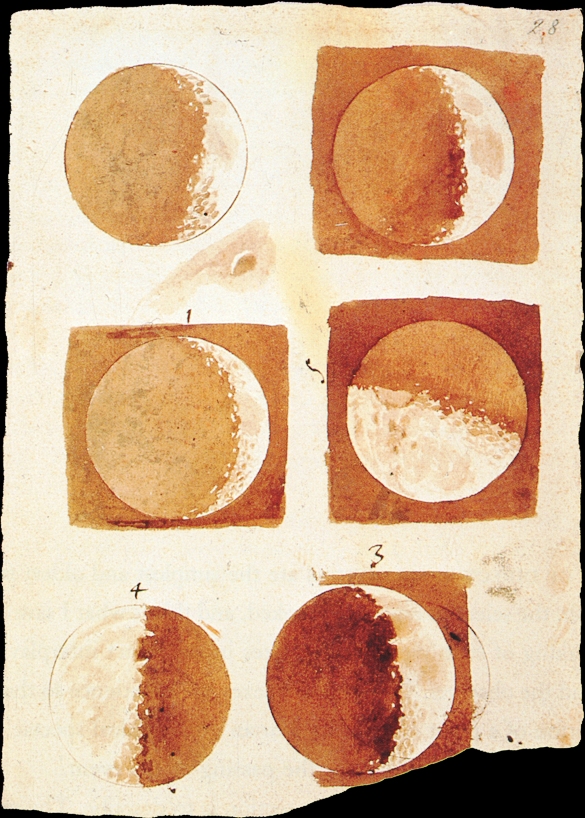
Galileo Moon Phases from here.
Soon after this, an International Peace Conference took place in The Hague, and diplomats returned to their home countries with news of this exciting new instrument.  One of these diplomats, Paulo Serpi, told a friend of his, Galileo Galilei, about Lippershey's invention.  Although Galileo did not immediately begin modifying the device, scraps of shopping lists exist for "organ pipe, Greek resin, white sand, cannonballs (to grind the lenses) and large blanks."  Within a year, Galileo was standing above the roofs of San Marco square in the Campanile, demonstrating that you could see ships not visible to the naked eye to the Doge of Venice, Antonio Priuli on August 21, 1609.

And then?  Galileo turned the scope to the heavens.  In one year, 1610, he discovered the four large moons of Jupiter, spots on the sun, craters on the moon, the phases of Venus (forever dashing the hopes of those with a geocentric view of the solar system) and countless stars beyond the naked eye.

Io, Europa, Ganymede, and Callisto from here
In the four hundred years since Galileo's observations, telescopes have become more sophisticated, and technology allows us to make measurements of different parts of the electromagnetic spectrum, not just light.  We have scopes that use mirrors and antennae to collect UV, gamma, infrared, radio, and microwave wavelengths.  But don't just take this at face value: read Galileo and Beyond (cartoon citations 1, 2, 3, 4 and 5)
Adventures in Astrobiology.  Cathrine Prenot Fox, 2012.

It is difficult to capture the enormity and loveliness of the Hubble Space images in a cartoon.  This telescope has been orbiting earth since its launch in 1990 and there are thousands of astoundingly beautiful views of our universe.  Stars, nebulae, supernovas, and distant galaxies abound at the Hubble Site, and I hope you will take a moment (or a month) to peruse some truly amazing pictures.
Carina Nebula from here.  
The 'next generation' of space telescopes is supposed to be "Bigger, Better, and Colder!"  It will investigate the birth of stars, new solar systems, and evolving galaxies while orbiting a million miles from earth.

Until our next adventure,
Cat

Investigating the visible spectrum at the SETI Institute.  

Thursday, July 19, 2012

Bears in your Backyard

Adventures in Astrobiology
SETI Institute ASSET Program
Cathrine Prenot Fox

Quick quiz: what has eight legs, multiple knife-like appendages, can be boiled, frozen and exposed to pressure that would make us pop, and yet lives peacefully in our backyard on plants, algae and lichen?  Any guesses?  No?

I'd like to introduce you to members of the animal phyla Tardigrada.  There are about 1,000 different species of this group of microscopic animals commonly known as waterbears or moss piglets.  They were first "described" in 1773 by the German zoologist Johann August Ephraim Goeze.  After spending years cataloging aquatic insects and worms you can imagine his sense of wonder when he came across these:
Colorized SEM image of a Tardigrate from here.

What is particularly interesting to me about Tardigrates is their ability to survive extreme conditions.  As I alluded, they have been found on all of the continents, in pack ice, the Himalayas, brine water, fresh water, and in moss or lichen growing in your backyard.  This adaptability, and their tolerance for extreme conditions that most life cannot exist in has put them in a group of exciting organisms dubbed "extremophiles."

 Let me help you further make their acquaintance with an excellent video from Science Friday that so captivated one of my advanced biology students, Whitney, that she wrote a song about them:

Waterbears!  Waterbears!
My favorite phyla except oursssss.
Live in space, Himalaya, 
radiation and boiling cannot harm.


Waterbears!  Waterbears!
in Antarctica they surviveeeee.
Legs of eight, really great!
Live in moss and maybe Mars.


These are only the first two verses out of five, and since we never properly recorded it let me expose you to another song from Mal Webb.


Life as we know it is enriched by an understanding of extremophiles, as it may change the parameters we use when looking outward into our solar system and the universe for indicators of life.  Why don't you read a little more about them in Bears in your Backyard (cartoon citations 1, 2, 3, and 4)?
Adventures in Astrobiology.  Cathrine Prenot Fox, 2012.  


Grand prismatic spring in Yellowstone National Park from here.
You may not be able to sample deep sea vents for six foot long tube worms, or travel to Yellowstone to see the bacteria thriving in Grand Prismatic spring, but you can easily collect and view a variety of tardigrades by following these excellent instructions.  Perhaps you may even find a relative of one of the ones that was sent to Mars's moon, Phobos in 2011.

Best of luck!
Until our next adventure,
Cat


All right, I just can't help myself: two more links.  A great cartoon from Small Science Zines:
smallsciencezines.blogspot.com
...and a final word from the beloved waterbear:
From here.


Tuesday, July 17, 2012

Adventures with the SETI Institute

Adventures in Astrobiology
SETI Institute ASSET Program
Cathrine Prenot Fox

I can trace my curiosity about life in the universe to the summer of 1987.  My family went wilderness canoeing in the Adirondack Mountains of New York State (as we always did).  That summer though, during a game of 'tag frisbee,' I got hit in the eye with the offending disc and our vacation was cut short.

I could see fine out of my uninjured eye, but my doctors worried that I wouldn't regain sight in my right unless they blinded both.  I was left with enormous white-rimmed black glasses that obscured a patch over my good eye and protected my slowly returning sight.  Any daylight that seeped in hurt my fledgling eye and gave me, well, blinding headaches.  To add insult to injury, the August heat lay like a thick blanket over the Hudson Valley during the day.  I pulled the blinds, put a fan in the window, and became nocturnal for a few weeks.

At night it was cool, the 17 year cicadas roared like miniature chainsaws, and my father broke out his telescope.  I could see better in soft blacks and greys, and when I looked through the scope I found I could clearly make out planets, stars and the edge of the Milky Way.

"How many stars are there out there, do you think?" I asked my father after a deep look.

My father, an ardent admirer of Carl Sagan, paraphrased him: "Billions upon Billions of stars!  I think the size of the cosmos might be beyond our understanding."

"And do you think there might be someone out there doing the same thing that we are doing, looking out at us?"

He again reverted to Sagan, although I didn't realize it until years later: "If we are alone in the universe, it sure seems like an awful waste of space." (Sagan was paraphrasing Thomas Carlyle)

This summer I will be taking a 'Voyage Through Time' with the SETI (Search for Extraterresterial Intelligence) Institute, NASA, and the California Academy of Sciences as part of an astrobiology curriculum and professional development experience in San Francisco, California.  I'll get to learn about how our planet and universe formed, theories about life and its development, and our place in history and the cosmos.  Why don't you read about it in Adventures with the SETI Institute? (Cartoon citations 1, 2, 34 and 5).
Adventures in Astrobiology.  Cathrine Prenot Fox, 2012.


Perhaps if I am lucky they will even teach me how to 'tighten my foil hat so I can get the signal in real clear like.'  Either way, this looks like the beginning of an interesting and exciting Voyage Through Time.  I hope you will come along and join me.

Until our next adventure,
Cat