Tuesday, August 7, 2012

To Infinity and Beyond

Adventures in Astrobiology
SETI Institute ASSET Program
Cathrine Prenot Fox

There is a great film that profiles recent Harvard Graduates and their misconceptions about what causes earth's seasons.  The majority of them very eloquently describe that the earth is closer to the sun during the summer... ...incorrectly.  Instead of extolling the virtues of my alma mater, as I can explain this scientific phenomena, I invite you instead to take a quiz to explore your own misconceptions about cosmic distances.  You can follow the link, or see below.  The answers follow.

1. Which of the following four diagrams most accurately depicts the shape of Earth's orbit around the Sun? 


2. Which of the following responses most closely explains why it is hotter in New York in June than it is in December?
A. The Sun gives off more heat energy in June.
B. Earth is closer to the Sun in June.
C. The Northern hemisphere is closer to the Sun in June.
D. The Sun is higher in the sky and provides more hours of daylight in June.

3. Put the following objects in the correct order, starting with the object that is closest to Earth and ending with the object that is farthest away. Circle one.
A. Moon, Sun, clouds, Pluto, stars
B. Clouds, stars, Moon, Sun, Pluto
C. Clouds, Moon, Sun, Pluto, stars
D. Clouds, Moon, Sun, stars, Pluto

4. Sometimes the Moon looks like this

And sometimes the Moon looks like this

What causes the Moon to change its appearance this way?
A. As the Moon orbits Earth, Earth's shadow covers the Moon.
B. Clouds block part of the Moon from our view.
C. As the Moon orbits around Earth, we see different views of the Moon's sunlit side.

5. Which of the following drawings most closely depicts the distance between Earth and the Moon? Circle one.


(Reprinted from here.  Great explanations of answers are also available from this site.)

Ready with your scratch paper?  The correct answer are:
A (42% of high school students answered this correctly out of a sample of 13,787), D (37% correct), C (64% correct), C (67% correct), and A (36% correct).  

Full disclosure: I did not get a gold star on this quiz.  Granted, my degree is in biology, and I have never taught astronomy, but still... ...it made me think that we all might need some education in cosmic distances.  

The moon is 240,000 miles from the earth, and the sun is 93,000,000 miles away!  As we get farther away from our solar system the distances are almost beyond comprehension.  They might seem like they are To Infinity and Beyond (cartoon citations 1, 2, and 3).
Adventures in Astrobiology.  Cathrine Prenot Fox, 2012.

Until our next adventure, 
Cat


Wednesday, August 1, 2012

Galileo and Beyond

Adventures in Astrobiology
SETI Institute ASSET Program
Cathrine Prenot Fox

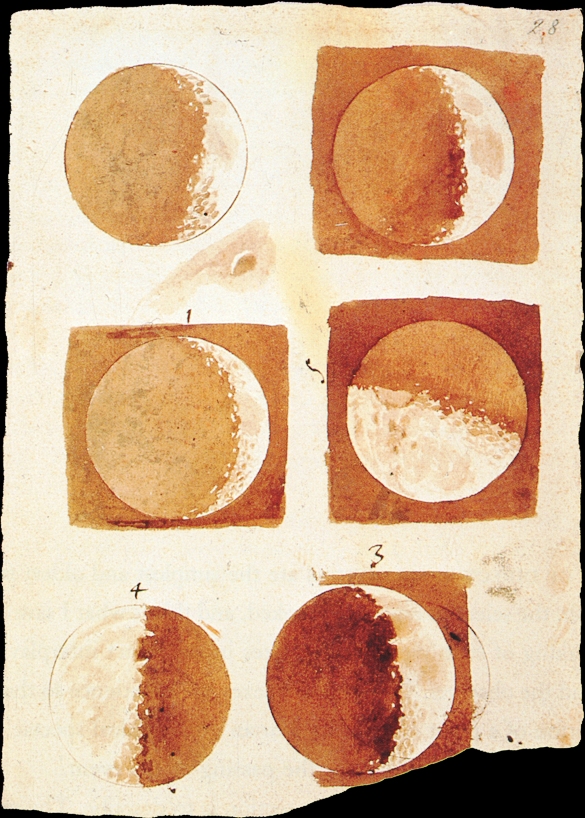
I have always been fascinated by the curious sequences of events that form history.  Take the telescope.  A spectacle maker named Hans Lippershey (the spelling of his last name is a matter of some quite passionate debate) ground some lenses, put them into a tube, and pointed that instrument some distance away.  Voila!  Long distance sight!  Lippershey traveled to The Hague to meet Prince Maurice of the Netherlands and presented the instrument to the government.  He applied for a patent on this instrument in 1608... ...and was denied.  They were too easy to build.

Galileo Moon Phases from here.
Soon after this, an International Peace Conference took place in The Hague, and diplomats returned to their home countries with news of this exciting new instrument.  One of these diplomats, Paulo Serpi, told a friend of his, Galileo Galilei, about Lippershey's invention.  Although Galileo did not immediately begin modifying the device, scraps of shopping lists exist for "organ pipe, Greek resin, white sand, cannonballs (to grind the lenses) and large blanks."  Within a year, Galileo was standing above the roofs of San Marco square in the Campanile, demonstrating that you could see ships not visible to the naked eye to the Doge of Venice, Antonio Priuli on August 21, 1609.

And then?  Galileo turned the scope to the heavens.  In one year, 1610, he discovered the four large moons of Jupiter, spots on the sun, craters on the moon, the phases of Venus (forever dashing the hopes of those with a geocentric view of the solar system) and countless stars beyond the naked eye.

Io, Europa, Ganymede, and Callisto from here
In the four hundred years since Galileo's observations, telescopes have become more sophisticated, and technology allows us to make measurements of different parts of the electromagnetic spectrum, not just light.  We have scopes that use mirrors and antennae to collect UV, gamma, infrared, radio, and microwave wavelengths.  But don't just take this at face value: read Galileo and Beyond (cartoon citations 1, 2, 3, 4 and 5)
Adventures in Astrobiology.  Cathrine Prenot Fox, 2012.

It is difficult to capture the enormity and loveliness of the Hubble Space images in a cartoon.  This telescope has been orbiting earth since its launch in 1990 and there are thousands of astoundingly beautiful views of our universe.  Stars, nebulae, supernovas, and distant galaxies abound at the Hubble Site, and I hope you will take a moment (or a month) to peruse some truly amazing pictures.
Carina Nebula from here.  
The 'next generation' of space telescopes is supposed to be "Bigger, Better, and Colder!"  It will investigate the birth of stars, new solar systems, and evolving galaxies while orbiting a million miles from earth.

Until our next adventure,
Cat

Investigating the visible spectrum at the SETI Institute.